Friday, February 21, 2014

Thank You, We Are Comfortable Where We Are: A.W. Roberson Part 2

by Kristine Schmucker, HCHM Curator

This post is Part 2 of a three part blog article featuring the life of A.W. Roberson. Roberson was a person who believed in equality and spent his life looking for opportunities to achieve this in Harvey County. To read Part 1 click here, Part 3 will be published next week. 

In the late 1930s through the 1950s, Newton, Ks was a segregated town. Restaurants and drug stores refused to serve black patrons unless they went around to the back door.  Black people were not allowed to stay in hotels, swim in the swimming pool or get their hair cut at barbershops.  The movie theater had sections designated for black people to sit.  Black students were allowed to play football with white students, but not basketball.
1944-45 Railroader

A.W. Roberson and others saw opportunities for change.
Main Street, Newton
ca. 1950s
After the 1954 U.S. Supreme Court decision in Brown v. the Topeka Board of Education, Roberson realized that anyone who refused to serve a black person could be sued.
"So, a group of us, both blacks and some whites who agreed with our cause, went downtown and went from one end of Main Street to the other, visiting each business.  We'd send someone in, and if they were refused service, they were to brush the back of their head as a signal.  Then I'd come in and talk to the owner, and most often, they'd get served." (Newton Kansan, 15 January 1987)
Wayne's Tavern, 525 Main, Newton
1949 The Newton Guide
HCHM Photo
According to Roberson, only one storekeeper said, "he would close before he would serve blacks, but he eventually served us anyway."  The first Newton restaurant, other than the Harvey House,  to allow black citizens to regularly sit in the main dining area  to eat was the Guest House in 1957.


The Rex Theater, 214 N. Main, Newton, 1946

Movie theaters were another place of segregation. Roberson came up with a plan. He and his wife decided to go to see a movie. They arrived early when the bright overhead lights were on and they could be clearly seen.  They sat in the center of the fifth row - not in the section reserved for minorities.  If anyone asked them to move, Roberson planned to say, "Thank you, we are comfortable where we are."  No one asked them to move, although Roberson noted that his wife was really not very comfortable.  They went several more times and nothing was said.  Roberson then encouraged others in the black community to do the same thing, "to be calm, to talk nice, to keep cool, to be polite to anyone asking them to move."  They also agreed that they would need to be carried out if they were ejected.  The separate section for blacks and other minority groups disappeared and people sat where they wanted to.


Sources:
  • Newton Kansan 29 May 1992 - announcement
  • Newton Kansan 1 June 1992 full obituary
  • Newton City Directories 1948, 1952, 1954
  • United States Census, 1940
  • United State Public Records Index, 1 August 1986 Residence
    • 1213 N Walnut St/ Newton, Ks
  • United States Social Security Death Index
  • Newton Kansan, 15 January 1987
    • Bartel, Matt, "Roberson Tells of Struggle for Housing Here" and "Roberson Worked for Equal Rights Here"
  • Kreider, Robert S.  Looking Back into the Future. Bethel College, North Newton, Ks, 1998 
    • 1978:  A.W. Roberson-Peacemaker.  Originally appeared in the Mennonite Weekly Review, 2 April 1978
  • Lehn, Cornelia.  Peace Be With You.  Newton, Ks: Faith and Life Press, 1980.  
    • "Ministry of Reconciliation: A.W. Roberson, 1944", p.100.
Connect with us on
or

Friday, February 14, 2014

Now, We and the Neighbors Get Along Just Fine: A.W. Roberson Part 1

by Kristine Schmucker, HCHM Curator


When the words, "Civil Rights" are used, most think of Rosa Parks, or Martin Luther King.  However, Harvey County had its own Civil Rights worker by the name of Augustus W. Roberson.  In the 1940s through late 1950s, A.W. Roberson was quietly, peacefully changing the community he lived and worked in.  When he died in 1992, his obituary quotes his daughter, who said, 
"A lot of people have called to offer their condolences and every one of them said he had a very strong impact. . . He had a love of God and a love of God's people."(Beverly Roberson Jackson, Newton Kansan 1 June 1992)  

This post is the first of a three part series about A.W. Roberson and the difference he was able to make in Harvey County.


Augustus W. Roberson
Newton Kansan Collection
HCHM Photos

When Augustus W. Roberson moved to Newton, Kansas with his family in the mid-1940s he thought, "Thank God I'm going to a free state."  However, much to his disappointment, he soon learned that "somethings were worse than anything I had seen in Texas" where racial segregation was still legal. (Newton Kansan, 15 January 1987) Roberson would spend the next 48 years working to "end racism and discrimination in the community." (Newton Kansas, Obituary, 1 June 1992.)

The grandson of slaves, A.W. Roberson was born July 7, 1907 to Anthony Roberson and Maggie Woodrow in Savoy, TX.  Anthony Roberson worked on the railroad maintenance and safety crew. His father also served as a minister and young  Roberson joined the church as age 9.  Of his growing up years in Texas he later recalled, "if church was open we were there." He married Ora C. Burnett in 1937 in Denison, TX.  They had two daughters. Throughout his life, his faith in God was very important to him and helped him overcome great obstacles. 

Another guiding force was his firm belief instilled in him by his father that "everyone was one of God's creatures and were all deserving of rights." (Newton Kansas, Obituary, 1 June 1992.)


Upon his arrival in Newton, Roberson observed that employment for black people was limited in Newton.  Most worked for the railroad, as household servants or in jobs related to maintenance. Roberson worked for the U.S. Postal Office.  Because he worked for the government, he did not have to fear the harassment that others experienced from local employers if they spoke up.  So, he began to push for equal rights.

First, he approached the Newton Chamber of Commerce.
 Directors of the Newton Chamber of Commerce
1939-1940 and 1940-1941
HCHM Photo
He questioned the members if there had ever been a black member. The answer was that none had ever applied.  Roberson applied to become a member and was accepted by unanimous vote.  Getting accepted was only the first hurdle.  The Chamber met at the Ripley Hotel, which did not allow blacks in the dining room.  

Roberson recalled that he
"would show up about 15 minutes early and sit in the lobby, so everyone could see me there as they came in for the meeting.  After awhile, they said it was time to eat and I got up just like everyone else and went to the table and sat down."  (Newton Kansan, 15 January 1987)


He left one seat between himself and the next person, "that way, whoever sat in that chair knew who they were sitting next to." Roberson was the first black person to sit to eat at the Ripley Hotel. He also worked to strengthen the local chapter for the NAACP.

Finding a home also proved to be another opportunity for Roberson to break down some racial barriers.

When his family first arrived in Newton, they boarded with U. S. Rickman, a black plumber.  The Roberson's wanted a home of their own.  Later, Roberson recalled his experiences purchasing a house.

"I'd call the local Realtors about a property and the'd say 'fine, come on over and we'll show you the place.' But when I got there and they saw I was black, they'd say this or that condition had come up since I called and the property was no longer available.  Then, they'd offer to show me some bungalow over in the black section of town."
Roberson did not want to live in a bungalow. So, he kept trying. Finally, he was able to purchase several lots near 12th and Walnut at a tax auction. The neighbors were all white.
"From the very start, I had people offering to buy the lots.  As time went on, they started telling me to name my price, they'd pay anything. They just simply didn't want blacks in the neighborhood."
Roberson held on to his lots and purchased a house from east of Goessel to move to Newton at his address 1213 N. Walnut.  At first there was some concern that there might be trouble.  Roberson took some time off of work to stay home.  He recalled that the neighbors "would gang up out front.  But nothing ever came of it."  

In 1987, Roberson reflected that "now, we and the neighbors get along just fine." 

Next weeks post will feature Roberson's experiences with downtown businesses.
Sources:
  • Newton Kansan 29 May 1992 - announcement
  • Newton Kansan 1 June 1992 full obituary
  • Newton City Directories 1948, 1952, 1954
  • United States Census, 1940
  • United State Public Records Index, 1 August 1986 Residence
    • 1213 N Walnut St/ Newton, Ks
  • United States Social Security Death Index
  • Newton Kansan, 15 January 1987
    • Bartel, Matt, "Roberson Tells of Struggle for Housing Here" and "Roberson Worked for Equal Rights Here"
  • Kreider, Robert S.  Looking Back into the Future. Bethel College, North Newton, Ks, 1998 
    • 1978:  A.W. Roberson-Peacemaker.  Originally appeared in the Mennonite Weekly Review, 2 April 1978
  • Lehn, Cornelia.  Peace Be With You.  Newton, Ks: Faith and Life Press, 1980.  
    • "Ministry of Reconciliation: A.W. Roberson, 1944", p.100.
Connect with us on
or

Friday, February 7, 2014

Now Here's What You've Been Waiting For: Beatles '65 Album

by Kristine Schmucker, HCHM Curator

Do you remember where you were when the Beatles first performed on the Ed Sullivan Show?  Where you one of the many that were "two inches from the screen, screaming"?  This weekend marks the 50th anniversary of the debut of the Beatles in the United States, so we are sharing an album in our LP collection, Beatles '65. 
The music group that we know as the Beatles got its start in Liverpool, England in 1958 when John Lennon, Paul McCartney and George Harrison began performing together.  Ringo Starr joined the group in 1962.  Two years later, on February 9, 1964, the Beatles performed on the Ed Sullivan Show in New York for a crowd of screaming teenagers.


Over a seven year period the group released 13 original albums, changing music forever.

On December 15, 1964, the Beatles released Beatles '65 with all new songs mostly composed by John Lennon and Paul McCartney.  Recorded in London studios between June and October 1964, this was their first new American album released since July 1964.  The Album went straight to #1 on the charts and stayed there for nine straight weeks.


Beatles '65 Album
HCHM LP Collection
The album included eleven new songs including I'll Be Back, She's a Woman, and Honey Don't. The album was a huge success with sales passing the three million mark.

To listen to songs from the album go to: Beatles '65 Album.

What was your favorite Beatles song?

Sources
  • http://www.beatlesebooks.com/beatles'65
  • http://edition.cnn.com/2014/02/07/business/opinion-beatles-coudnt-happen-today/index.html
  • Beatles '65 HCHM LP Collection.
Connect with us on
or

Friday, January 31, 2014

The Santa Fe Reading Room

by Kristine Schmucker, HCHM Curator

Working for the Santa Fe Railroad often meant days away from home and family for conductors, engineers and brakemen. During layovers, employees could spend time in the "Reading Room" provided by the Santa Fe.

Main St., Newton, KS ca. 1911

A social center for railroad employees, the Reading Room in Newton had a library staffed by a librarian and attendant. In some locations, the Reading Room also had rooms to board for employees.


AT and SF Reading Room on W 4th, Newton
1900
Note men on porch roof holding pool cue sticks.

There was also space for games and entertainment.  In Newton, the game of pool was a popular way to pass the time.  Traveling stage shows provided entertainment.   

The Santa Fe Reading Room was torn down in 1929 and the Fred Harvey Laundry building was constructed on the site.

Source

  • HCHM Photo Archives
  • Hurley, L.M. "Mike".  Newton, Kansas #1 Santa Fe Rail Hub 1871-1971. Newton, Ks: Mennonite Press, 1985. 
Connect with us on
or

Friday, January 24, 2014

At U.S. 50 and First Street: Walton Service Stations

by Kristine Schmucker, HCHM Curator


2014 is off to a great start at the Harvey County Historical Museum and Archives!  Two exhibits opened on January 18 and visitors enjoyed a wonderful Sunday Afternoon Program given by Marti McCartney on January 19.  With this post we will resume our blog schedule of posting once a week.  Look for new posts to be published on Friday of each week.

The small Harvey County town of Walton is our featured community for 2014. Throughout the year, we will post stories related to Walton history. 

Because of the location along the busy Highway 50, Walton is a convenient stop for travelers. As a result service stations have served an important role in the community.  The history of a gas station in a community can be hard to track.  The following is based on information that we have at the Harvey County Historical Museum and Archives.  If you have additional information, corrections or photographs, please contact HCHM.

In 1905, Sylvanus F. Bowser developed a pump that would take gas out of a barrel and fill the tank of an automobile.  The first "filling stations" were often a pump placed on the sidewalk in front of a general store.   

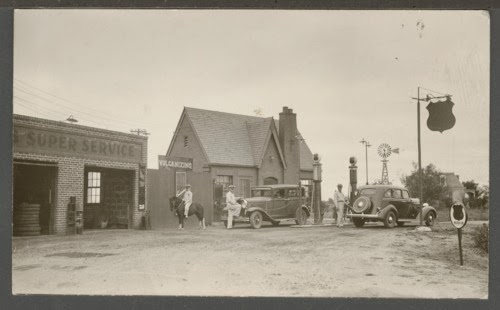
Advertisement for Wayne Cut 276
in Motor Age Magazine, 1912 
This caused congestion as horse-drawn vehicles and pedestrians were also on the roads and sidewalks near the store. Soon the idea of a separate 'drive-in' business was adopted.  By the 1920s, the major oil companies were trying to make their product stand out and identifiable with eye catching buildings and signs. 

Standard Oil Co. Service Station, Walton, Ks 

One of the earliest Walton stations was owned and operated by Harry Davis. The Standard Oil Co Service Station was constructed in the early 1920s. The original location is not known at this time, but in the mid-1920s the station was moved to the intersection of 1st Street and Highway 50 to take advantage of the traffic on the new highway.  Davis ran the business from 1923 to 1931.  Dutch Wise was the owner/operator from 1931 to 1937. 
 Standard Oil Station, Walton, 1925
Located at US 50 and !st Street
Owned/operated by Harry Davis
Features two gravity-flow pumps


Standard Oil Co. Service Station, Walton
Model constructed by Leslie Walton 
based on above photograph.
"House with Canopy" style ca. 1920
HCHM Service Station Collection


Gravity Flow Pumps

The owner just set down his coke!

Walton Oil Co. Service Station, Walton, Ks.


Walton Oil Co., Phillips 66
Frank Wise, Owner/Operator

Frank Wise opened Walton Oil Co using the Phillips brand of fuel in the 1930s at the corner of US 50 and First Street in Walton.  He operated a service station in Walton until 1950.


Walton Oil Co., Phillips 66
Frank Wise, Owner/Operator

Walton Oil Co.,Phillips 66
 Frank Wise Owner/Operator on the right
Walton Oil Co.,Phillips 66
 Frank Wise Owner/Operator
Along US 50 at West Main, Walton


Other Walton Service Stations based on information collected by Richard Hege.
  • L.W. Ames Oil Co., owner: Levy Ames; 1923-1930
    • Location south side of Main/east side of 1st.
  • Walton Oil Co. Phillips 66; owner: Gail Reusser,  1938-1963.
  • Farmer's Grain Co-op: Co-op, 1963-2001.
  • Ray Rillings: 1965.
  • B.J.'s: owner: Bill and Gene Tatro and Jeff, Jess and Virgil Hiebert - early 1990s.
  • Hilltop Convenience Store: Rick and Twila VanRossun, ?-2005.
  • Ampride: Ampride, 2001-2005.

Sources:

  • Hege, Richard.  HCHM Service Station Collection.
  • HCHM Photo Collection.
  • Anderson, Scott.  Check the Oil: Gas Station Collectibles with Prices, 1996
  • Jakle, John A. and Keith A. Sculle.  The Gas Station in America Baltimore: John Hopkins University Press, 1994.
  • Rosofsky, Ira. "History of the Gas Station", www.vintagegas.com.
  • Vieyra, Daniel I.  Fill'er Up: An Architectural History of America's Gas Stations. Macmillan, 1980
  • Witzel, Micheal K.  The American Gas Station: History and Folklore of Gas Stations in America. Barnes and Noble Books, 1999.
Connect with us on
or

Friday, January 10, 2014

The Video Game Craze

by Kristine Schmucker, HCHM Curator

"Games such as 'Pac-Man' and 'Space Invaders' were going into virtually every location in the country, with the exception of maybe funeral parlors, and even a few funeral parlors had video games in the basements.  Absolutely true.  I believe churches and synagogues were about the only types of locations to escape video games." Eddie Adlum in The Ultimate History of Video Games "The Golden Age: 1979-1980"


Do you have fond memories of slipping to the convenience store for a quick video game over your lunch hour?  Did you get caught up in the maze-like game where a cute little creature gobbled up dots while avoiding 'ghosts'? If so, you were part of the "Golden Age" of electronic games that started in 1979-1980.  The game that started it all was Pac-Man.

Developed by Toru Iwatani, a Japanese programmer at Namco, the simple game gave us "the first digital superstar" with the Pac-Man arcade game.  Iwatani set out to design a game that was essentially nonviolent and that would appeal to women. He was successful and electronic games became a part of our culture.  

Pac-Man Trivia
  • Iwatani got his inspiration for the "dot-craving maze crawler" from a missing slice of pizza.
  • The original name for the game was Puck-Man.
  • Between the Japanese and American versions of the game there were 23 distinct names for the 'ghosts'.


A selection of arcade video games will be available to play in HCHM's exhibit, Games People Play.  These games will rotate periodically, so watch facebook for the current games available. 

Starting January 18, 2014, come in and play Pac-Man, Joust, and Kangaroo


Thank you to Keith Neufeld who is loaning a selection of his collection to HCHM for this exhibit.
Sources

  • DeMaria, Rusel and Johnny L. Wilson. High Score: the Illustrated History of Electronic Games, McGraw-Hill/Osborne, 2004.
  • Herz, J.C. Joystick Nation: How Video Games Ate our Quarters, Won our Hearts, and Rewired our Minds. New York:  Little Brown and Co., 1997.
  • Kent, Steven L., The Ultimate History of Video Games: from Pong to Pokemon and Beyond-the Story Behind the Craze that Touched Our Lives and Changed the World. New York: Three Rivers Press, 2001.


 Connect with us on
or

Friday, January 3, 2014

At HCHM in 2013

The Best of 2013 . . . 

Most popular blog posts.


Jayhawk Raceway
HCHM Photo


HCHM Photo

Most popular facebook photo.

Anyone remember sliding down this?
Elephant Slide from Athletic Park
Privately owned
HCHM Photo

Digital Photographs

Our first photograph collection became available on line through a partnership with Ft. Hays State University Forsyth Library at: 


Featured Harvey County Community: Sedgwick

Sedgwick Depot
HCHM Photo


Lloyd Smith Collection


Traveling Exhibits


Following the Chisholm Trail
One of two exhibits installed at the Newton Public Library
HCHM Photo

Improvements 
Installing storm windows on the north and west side.
HCHM Photo 

New Storm Window

Getting ready for the Arcade Games

Myra on the Merry-Go-Round
Volunteers Painting the Merry-Go-Round


Programs and Fun


KMA
Joe Smiley with Myra, HCHM's ambassador at the July Ice Cream  Social
HCHM Photo


KMA
Red Hat Club at July Ice Cream Social
HCHM Photo


Board/Staff/Volunteer Christmas Party
Joe Smiley and Nancy Krehbiel
HCHM Photo

Connect with us on
or