Thursday, July 18, 2013

Harvey County Flashback: KG & E Fire February 1953

by Kristine Schmucker, HCHM Curator


Kansas Gas & Electric Co, 512 Main, Newton, ca. 1952
HCHM Photo Archives
Around 8:00 a.m. on Saturday, February 21, 1953, Virgil O. Brumback arrived at  his store, Brumback Paint & Paper Co. at 510 Main in Newton.  He noticed "smoke seeping through the floor at the rear of Gordon's Shop adjacent to his business."  He reported the fire. For the next several hours, both Newton and volunteer firefighters using  four trucks battled the blaze with heat so intense they could not get near the structure.  


One firefighter was "nearly overcome with smoke on two occasions."  William A. Rittstatter attempted to enter the building with a large water hose in an attempt to get at the fire base.  He had to retreat with the help of his fellow firefighters wearing masks.

KG&E Fire, 21 February 1953
HCHM Photo Archives
Fighting the fire was made more difficult by the freezing wind. Several fire fighters had water frozen in their hair due to the "water spray from the hoses."  Volunteers were an important  in fighting this fire.  According to the Kansan they helped "heave hoses and equipment to various places . . . helped police with traffic control . . . and manned large hose nozzels [sic], carrying two and one - half inch lines."
KG&E Fire, 21 February 1953
HCHM Photo Archives


Perhaps the most dramatic action of the day occurred when Newton Fire Chief, Ed Warhurst "personally made his way to the top of the blazing building and cut a hole in the roof so that the fire could 'get air'."  Warhurst later explained that if the pressure became too great in the building, "it might have exploded, spreading the flame. The hole in the roof was necessary to keep it from doing so." 

The Kansan editor credited the seventy-one year old Fire Chief with saving the surrounding businesses with his actions.


KG&E Fire, 21 February 1953
HCHM Photo Archives

The back portion of the block  long building collapsed about 10:45 and firefighters were able to get the upper hand.  Surrounding businesses, including Gordon's Ladies Wear Shop, Graber's Hardware and Brumback Paint & Paper Co.,  suffered smoke damage.

Throughout the morning "an estimated throng of over 2,000 people trampled the watery street and alley behind the building, witnessing the fighting procedure."

To thank the firemen, policemen and highway patrol officers that helped get the fire under control, a local restaurant, the Coffee Cup, gave them "the run of their dinners for their efforts . . . when they can find the time."

The Kansas Gas and Electric Company had been in the 510 Main building since 1935.  Damage was estimated at $50,000 the KG & E building alone.

Those familiar with Newton history will note that the 500 block of Main was also the site of the devastating fire on August 4, 1914.

Sources

  • Newton Kansan, February 21, 1953, p. 1
  • "E.C. Warhurst, Fire Chief, Dies" Newton Kansan, 2 November 1956, p. 1.
  • HCHM Photo Archives
  • Newton City Directory,  1952, 1954.


Connect with us on
or
    

Thursday, July 11, 2013

"That Fly-Free Look!"

by Kristine Schmucker, HCHM Curator
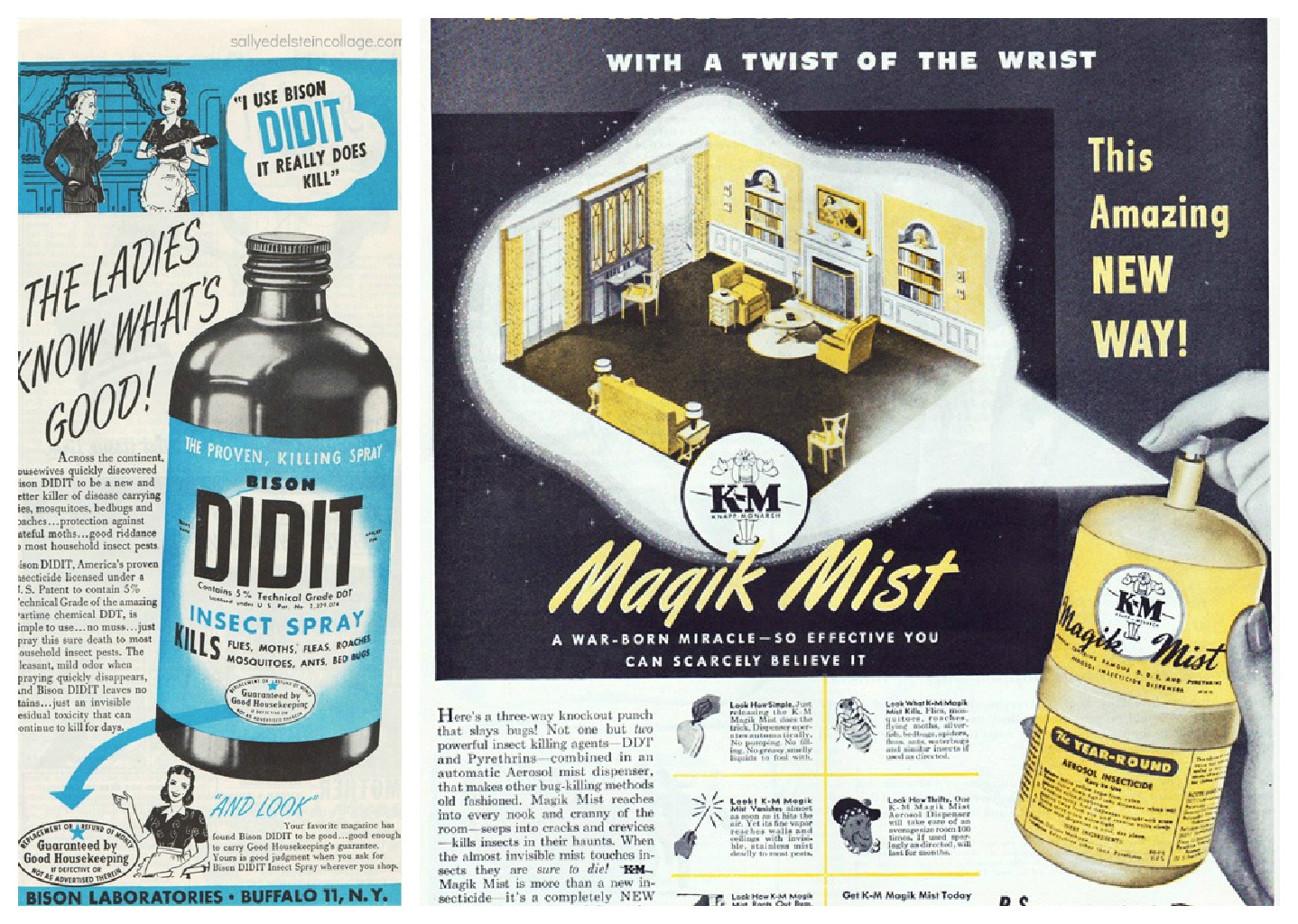
"Fly Eradication Program . . . Stop and think what it means.  No more arming yourself with a swatter and pursuing flies around your home all summer.  No flies in your restaurant or stores where you shop.  No flies if you want to sit in your yard this summer."  -Ad placed by the Junior Chamber in the Newton Evening Kansan Republican, 8 July 1949.
On a hot and humid summer afternoon, nothing is more annoying than a fly buzzing around.  Over the years various techniques have been tried to control flies and even eradicate them completely.  The Newton Junior Chamber of Commerce envisioned a "life without flies" in their 1949 ad and they asked for money to help in the cause.

Newton Evening Kansan Republican
8 July 1949

The ad offered tips for fly control from disposing of manure from livestock twice a week to maintenance of the outdoor toilet.  The use of DDT was also encouraged to control flies. 
"The most effective way is by the use of a spray gun or hand-sprayer with a DDT solution."
 At the time of the above ad, DDT was considered safe and used  regularly on farms and in homes. The Junior Chamber of Commerce's Program was even "sanctioned by Harvey County Medical Society."


DDT (dichlorodiphenyltrichloroethane) was first developed in 1873/74.  The chemical compound was a colorless, crystalline solid that was tasteless and almost odorless.  DDT did not gain widespread use until 1939, when it was discovered to help in the control of mosquitoes.  DDT was used throughout World War II to combat malaria and typhus among soldiers and civilians.  After the war, DDT was used extensively on American farms as a pesticide.  At one point, the annual production of DDT in the U.S. reached 220 million pounds.


In 1962, Rachel Carson published Silent Spring and called into question the indiscriminate use of the pesticide DDT.  She identified the threat to humans, wildlife, and especially birds.  DDT was banned in the US for agricultural use in 1972.  One result of the ban is the increase in the population of the bald eagle and the return from near extinction of the peregrine falcon. 


Without pesticides, people have to rely on the old fashioned way of killing flies.  Dr. Samuel J. Crumbine was an early advocate for healthy habits in Kansas. During his time as secretary of the Kansas State Board of Health from 1899 - 1924, he encouraged disease prevention through the use of simple slogans. 


Boys! Girls! kill the flies - Page
September, 1914
http://www.kshs.org/kansapedia/samuel-j-crumbine/12025
One of his more well-known campaigns  had the slogan, "Swat the Fly".  In 1905, Crumbine attended a Topeka softball game.  The chant of the crowd, "swat the ball", inspired his slogan of "Swat the Fly".  At about the same time, Frank H. Rose  constructed an object from a yardstick and a piece of screen and called it a "fly bat", but Dr. Crumbine renamed it "fly swatter" and the term stuck.   

Homemade Fly-swatter
HCHM  #91.15.12
Sources:
Connect with us on
or


Wednesday, July 3, 2013

House of Steel or "Why Am I Living in this Lunchbox?": Lustron Homes

by Jane Jones, HCHM Archivist
   
You have heard of the "Man of Steel," the new Superman Movie now showing. Have you ever heard of the House of Steel?  Hang a picture? Use a magnet.  Instead of just your refrigerator filled with magnets your whole house could become filled with magnetized reminders.  Not only would you water your outside plants, but you could lift that hose slightly and wash down your outside walls! No need to paint the house. The all-steel, pre-fab Lustron home provoked one owner to say, "Why am I living in this lunch box?"

From Luston home ad
     Newton has one Lustron Home at 408 Mead.  In 2001 it was featured on the Historical Society's Home Tour.  The house was built by M.R. Stauffer, Wichita contractor, in 1949.  The local overseer was Jean Coleman who was Stauffer's son-in-law and the person who persuaded Stauffer to build this unique home.  In fact, Coleman put down money to bring this project to fruition.
      An open house was held September 10, 1949 in Newton showing this rather unusual home.  It was all steel, insulated and heated, and erected on a concrete platform.  The home had built-in plumbing, electric wiring conduits and was equipped with all utilities.  An article in the Kansan described the house as having a "large" living room, dinette, utility room, two "commodius" bedrooms, a "large beautiful" bathroom and a "world" of closets and "built-in" fixtures.  Everything was as complete and handy as a "pocket in a shirt" which is probably real estate jargon for small and compact!  All Lustron homes in Kansas are now on the National Historic Register.
Lustron home, 408 Mead
      
     According to Elizabeth Rosin of Historic Preservation Services, LLC of Kansas City, MO from a letter received in December, 2000, 2500 Lustron homes were built nationwide between 1948 and 1950.  Of that number 100 existed in Kansas as of the year 2000.  Lustron home manufacturing was part of the suburban house building boom in America after World War II.  Due to the wartime economy there had developed a housing shortage. Returning GIs starting families wanted affordable housing.
     Carl Stradlund, a Swedish immigrant was a self-taught engineer and the founder of the Lustron Corporation.  These pre-fab homes were thought to be the future for middle-class home ownership.  Costing $8,000-$10,000 depending on the model, they were to be manufactured on an assembly line like automobiles.  In fact, automobile workers were first hire-es at the Lustron plant in Columbus, Ohio.  Most models had at least 30,000 parts and could be loaded on Lustron trucks, taken to the building site and put up in 72 hours. 
     Financial problems dogged Stradlund, as well as, Washington politics. Backed by the Reconstruction Finance Corporation Stradlund received an initial investment to start manufacturing his steel homes. But the company found itself in the middle of a tug-of-war between the idealistic Stradlund who just wanted to build affordable homes and Washington bureaucrats who wanted to skim money from the project. The RFC tried to get their cronies to become major stockholders in Lustron even replacing Stradlund.  Carl refused to fold and ended up losing the company. He "went bust in 1950, leaving millions in debt and thousands of factory workers unemployed."
      Now Lustron homes are special historic oddities representing a different time in American housing.

Sources:
 Historic Preservation Services, LLC December 26, 2000.
Lustron Home is Open to Guests.  Newton Evening-Republican Sept 10, 1949
Man of Steel: 2008 Farmers' Almanac
Lustron Luxury http:www.piranhagrphix.com/Lustron/
E-Mail from Gini Johnson, daughter of Jean Coleman June, 2013
Lustron: The House America's Been Waiting For: A Documentary Film by Ed Moore, Bill Kubota & Bill Ferehawk 2002. (loaned by Gini Johnson) 
    
Connect with us on
or
    

Thursday, June 27, 2013

Jump in Your Car and Come as You Are!

by Kristine Schmucker, HCHM Curator

A focus on the 1950s would not be complete without mentioning the drive-in movie theater.  Although first developed by a New Jersey inventor in the 1930s, the drive-in did not really take off until the 1950s.   In the post World War II period, Americans were prospering, had more leisure time, and were in love with their cars.  Anything that involved the car was bound to be a hit and Kansans were not an exception.  At one time Kansas had as many as 125 drive-in theaters.  Nationwide there were approximately 4,000.  Newton had two drive-ins and at least two indoor movie theaters during the 1950s.

On Sunday, July 19, 1953 Newton's second drive-in movie theater opened one half mile north of Newton on US Highway 81 with the bold invitation: " Jump In Your Car and Come As You Are!" 

Newton Kansan, July 18, 1953


The history of Starlight Drive-In remains something of a mystery. The theater is listed in the 1954 City Directory with a location of Hwy 81 North.  The Directories do not mention the Starlight Drive-In again until 1960.  In 1960, the Starlight Drive-In was located at Rt 1, Newton and owned by Lorin W. Kemp who also owned the Roxy Theater at 214 Main, Newton.    

The other Newton Drive-In is a little easier to track through the 1950s.  In the directories for 1952, 1954, 1958 and 1960, the West-Vue Drive-In Theater was owned and operated by Raymond Roberson.  The  drive-in was located on the west edge of Newton at Hwy 50 S.  Roberson also owned the Roxy Theater at 214 Main, Newton, until 1960

West-Vue Drive-In Theater
ca. 1970
HCHM Photo Archives


West-Vue Drive-In Theater
ca. 1970
HCHM Photo Archives

Do you have any memories of going to a Drive-In theater? 

From the Newton City Directories:

  • 1952 lists West-Vue Drive-In at Hwy 50 S.  In addition there were three theaters located on Main; the Chief (506), Regent (518), Roxy (214).
  • 1954 lists Starlight Drive-In at Hwy 81 North and West-Vue Drive-In at Hwy 50 S.
  • 1956 lists the Fox Theater (518 Main), Roxy Theater (214 Main) and West-Vue Drive-In.
  • 1958 lists the Roxy Theater and West-Vue Drive-In with Raymond P). Roberson as manager and owner.
  • 1960 lists Fox Theater (518 Main) manager M.E. Lehman; Roxy Theater (214 Main) owner L.W. Kemp; Starlight Drive-In (Rt 1) owner L. W. Kemp; and West-Vue (Hwy W 50 S) owner Roberson.


Sources

Connect with us on
or

Thursday, June 20, 2013

Harvey County Flash Back: 1953

by Kristine Schmucker, HCHM Curator


Harvey County Flash Back
1953

For a number of years it was a tradition at Newton High for the seniors to hold a Kid Day, where they came to school dressed as a small child.

This photo is from 1953 and was taken in the classroom of teacher J. Birch Stuart. 

NHS Senior Kid Day, 1953
J. Birch Stuart Collection
HCHM Photo Archives

KWCH 12 60th Anniversary Family Fun Day

Today, with our unlimited TV channels and stations devoted to news, to sports or even history, it is interesting to look back at all the changes that have happened to television in the last 60 years.  Sixty years ago, on July 1, 1953, KWCH Channel 12 first went on the air. The broadcast day went from 5:30 p.m. to 9:30 p.m.. Unlike today's 24 hours of programming, they were only on the air for four hours a day, which included a 15 minutes network newscast. 

 Dick Cornish was hired as a staff announcer when KWCH 12 "went live" in 1953. Photo courtesy: http://www.kwch.com/kwch-rew-60th-anniversary-changes-at-channel-12-20130213,0,6492611.photogallery -Roger Cornish / February 14, 2013

As broadcasting time increased, so did programming including several popular locally produced shows; Dialing for Dollars, Take Your Pick, Fifo the Clown, Woman's World and Hi Fi Hop.

http://www.kwch.com/news/60th/kwch-rew-ktvh-kwch-channel-12-hi-fi-hop-gave-teens-a-place-to-rock-n-roll-20130521,0,6517764.story
We are very excited about an upcoming event at the museum in connection with KWCH 12's 60th Anniversary.  On Saturday, June 29 from 10:30-12:30, we will be hosting an ice cream social in front of the Kellas School on the museum grounds as part of KWCH 12's 60th Anniversary Family Fun Day.  During this time,  an on-air personality from KWCH 12 will be at the museum. The ice cream and outdoor events are free.

There will also be a chance to enter a drawing for a $60 VISA Gift Card.

Inside the museum there will be 1950s memorabilia and photos in addition to our normal exhibits.  Museum admission will be reduced to 60% off of our normal $3.00 or $1.20. 

We hope you will join us on Saturday, June 29 for this fun day at the museum.

Sources:
Connect with us on
or

Thursday, June 13, 2013

A Fire Station and a Hotel: The Buildings in the 100 Block of North Main

by Kristine Schmucker, HCHM Curator
One of the great things about working at a museum is hearing the stories that can be triggered by an object, photograph or story.  When we post a story on the blog, facebook or include in an exhibit, we never know what new stories will come as a result.  The blog post on Newton's Peter Pan Ice Cream Stores was quite popular. We recently revised to include some of the facebook comments and printed the article in out Summer 2013 Newsletter.  Now, another chapter of the story has come to light.  Two longtime museum supporters and Harvey County natives read the newsletter article and shared their memories of the 100 block of North Main. 

Hotel Meridian and Sinclair Filling Station
2nd & Main, Newton
15 August 1968
HCHM Photo Archives
Thank you to John Wiebe, who took the time to write a letter describing his memories and to Tom Rose who called and visited with me.  The old ways of communication still work just fine.

"In the picture, you can see a garage door on the south side of the building." (Wiebe letter)

In his letter, Mr. Wiebe noted that the south side fire department was located at that location in the south part of the brick building.  The firemen may have lived above.  Wiebe recalled that "when the door was open you could see the fire engine."  Tom Rose shared his memory of the building as well.  When he was a young boy, the firemen would sit in front of the station on metal chairs.  Rose and his friends would ride bikes past and sometimes stop to visit with the crew.  And sometimes, the firemen would allow the boys to go inside and slide down the pole. 

A directory search revealed that Fire Station No 2 was located at 119 N. Main from approximately 1926 until 1948.  Between the 1948 and 1952 Directories, the new Fire Station was built at 200 East Third, Newton.
Fire Station No. 2, 200 East 3rd, Newton, 1953
HCHM Photo Archives
The Hotel Meridian/Cafe first appears in the directories in 1923 at 119-123 N. Main.  After 1926, the Hotel is listed as occupying 123 N. Main, with the Cafe at 121 N. Main, Newton.  The hotel was first managed by Lucia B. Oakes Millner and later by her daughter-in-law Winona Linville Millner Sloan.

Peter Pan Ice Cream Store appears at the 123 N. Main address from 1956 to 1966.

The buildings at 119-123 N. Main (seen in the 1968 photo) were torn down in approximately 1970. Today, Auto Parts is at this  location.  A new bank is also under construction on the lot where the Dairy Queen was located (for a history on the Dairy Queen building click here).

View of 100 Block of N. Main, June 2013
HCHM Photos
Sources:
  • Wiebe, John E. letter to Kris Schmucker, HCHM Curator, 29 May 2013.
  • Rose, Tom phone conversation with Kris Schmucker, HCHM Curator, 6 June 2013.
  • Newton City Directories 1919-1956
  • For a history of the Newton Fire Department before 1922 see Warhurst, Elvin E., "Early Fire Protection in Newton, Kansas, 1872-1922, compiled in 1995. HCHM Archives.


Connect with us on
or

Thursday, June 6, 2013

AVI Car No 12: The Best in Public Transportation

by Kristine Schmucker, HCHM Curator

In one corner of the museum stands a dusty chair.  The leather upholstery is cracked and torn.  It certainly does not look  to comfortable.  


This artifact is a reminder of a brief time in Harvey County history before highways and interstates, when roads were often poor and the best way to get around was  by the AVI.

The Arkansas Valley Interurban was a system of electric rail cars that connected three county seats, Wichita, Newton and Hutchinson, and several smaller towns in south central Kansas from 1910 to 1938. Freight service continued until 1942. At the height of use, the A.V.I. had 60.5 miles of track.
Isley Map

Laying AVI Track
1910
HCHS Photo Archives
The A.V.I track was laid into Newton and the first car made the trip on October 11, 1911.

Corner of 5th & Main, Newton
October 11, 1911
HCHM Photo Archives

A one way ticket  from Wichita to Newton was .65 cents and took about 75 minutes. The combination passenger, smoker and baggage cars could travel at about 45 mph.

A.V.I. Car at 5th & Main, Newton
October 11, 1911
HCHM Photo Archives
According to Webster T. Bolin, "It stopped anywhere along the track letting on hunters or ladies with baskets of eggs."  The stop at Sand Creek had a small shelter for people to wait.

AVI Shelter House, Sand Creek Station
ca. 1912
HCHM Photo Archives
AVI Car No. 12 "The finest passenger interurban car."

The seat in our collection comes from AVI Car No. 12, which in 1917, "embodied the latest developments in steel construction and the finest passenger interurban car." Constructed by American Car Co., the exterior was painted red and cream. 
AVI Car No 12, 1934
Isley, p. 34
An article in the Brill Magazine (1917) quoted in Isely described the new car.
"It is big, handsome, thoroughly modern and the roomy, bright and attractive interior with its well-planned compartments and comfortable seats will doubtless win additional traffic.

Interior AVI Car No. 12
Comfortable seats, big windows "afforded the best in public transportation."
Isely, p. 29
Each side of the car has 14 windows . . . all doors, sashes, moldings and small panels are made of cherry stained mahogany and the varnish rubbed to a dull finish.  The ceiling is cream color to increase the light be reflection.
The main and the smoking compartments are finished in the same style and are separated by a glazed partition. . . the seats are of the Brill stationary-back type with headroll . . . and upholstered in dark green plush. . . . Those in the smoking compartment are the same except they are upholstered in leather and four have reversible backs.
The toilet room at the rear of the main compartment has a sidewall type of flush closet with overhead tank."

AVI Car No. 12 at Sedgwick Depot
November 11, 1937
Eugene Sabin Collection
HCHM Photo Archives


AVI Car No 12, 1938
Isley, p. 34
Car No. 12 carried passengers until 1938, when passenger service was stopped.  At that time, windows were boarded up and seats removed to use as an express car for freight.  When the AVI disbanded, this car was sold to a private individual and used for feed storage at Bentley, Kansas.

Sources:
  • Chandler, Allison.  Trolley through the Countryside.  Denver, Sage Books, 1963.
  • Isely, Malcolm D. Arkansas Valley Interurban: Wichita, Newton, Hutchinson April 1956.
  • Leonard, Jean D. "Harvey County's AVI was the 'car of the people'." Newton Kansan, June 10, 1981. 
  • Most of the remaining traces of the A.V.I. are on private property or are very difficult to get to, but through the magic of the internet you can take a virtual tour at this site- http://bridgehunter.com/category/railroad/arkansas-valley-interurban-railroad/


Connect with us on
or