Thursday, October 25, 2012

Kansas Museum Association Opening Reception


The museum is quiet this morning, but last evening the lights were on, and there was food and laughter in every corner. The Harvey County Historical Museum & Archives was the last stop on a progressive supper through several of Newton's museums.  This was the kick-off event for the Kansas Museum Association Annual Meeting held in Newton.  The Kansas Sports Museum & Hall of Fame served appetizers.  Then, the participants went to Kauffman Museum for the main meal which included German sausage and zweibach.  Dessert was served at HCHM. 

HCHM Board President, Nancy Krehbiel serving capirotada.
Capirotada  (Spotted Dog) and Ersatz (Quick) Dobos Torte were served. 

Nancy Krehbiel & HCHM Director Deb Hiebert
Canteen Peanut Butter Cookies and M&M's were served with coffee and ice water.

HCHM Curator, Kris Schmucker serving Canteen Cookies.

The exhibits were all open.


 Friendships were made and renewed.


The Kansas Museum Association Annual Meeting will be taking place on Thursday and Friday of this week at the Meridian Center, Newton.


Thursday, October 18, 2012

"Welcome Friends - Have a Coke": The Harvey County U.S.O. - Part I

"The U.S.O. and Red Cross in Kansas, especially in Newton, are doing a commendable job in meeting trains, seeking out the soldiers and giving them cookies, cigarettes, fruit, coffee, matches, stationary,candy and reading matter in a manner that none of the other states visited can boast."  -Undated clipping, Evening Kansan Republican, "A letter from a  Mother"  HCHM USO Piano File.
~~This is the first of a three part series on the Harvey County U.S.O. during World War II~~ 

Museums and Archives house many one of a kind objects, documents and photographs.  These irreplaceable objects are links to our community's past and the people that lived through historic events.  Sometimes the object itself is nothing special, common place, but the association with event and people make it unique.  The Harvey County Historical Museum & Archives has two objects related to Harvey County's U.S.O. during World War II, a Kreiter upright piano and the U.S.O. train cart.  This first post will give a brief history of Harvey County's U.S.O. and recipes for the cookies served to the traveling soldiers.

Canteen Sign
The Harvey County Chapter U.S.O. was organized in Newton on April 10, 1942 with representatives from each Harvey County town on the governing council.  At first, the U.S.O. operated in connection with the Red Cross Canteen on East 5th in Newton.  However, by October 1, 1942 the U.S.O. "Troops in Transit Lounge" was located just west of the depot at 421 Main, Newton.

Harvey County Chapter Canteen
ca. 1945
A group was formed to answer the need some saw to provide services to soldiers as they traveled through Newton on the trains. Because trains stopped longer in Newton to refuel and pick up supplies, soldiers had time to get off the train and look for food and entertainment. 
"Welcome Friend, Have a Coke"Sign above canteen door.
The 'Troops is Transit Lounge', staffed largely by community volunteers, was a place where soldiers could go while they were in Newton. The Lounge was furnished with comfortable chairs, writing desks, and game tables. The U.S.O. also provided food and drink. Volunteers would also meet the soldiers on the trains if time did not allow them to come to the Lounge. The U.S.O. Cart, seen in the photo below, was pushed down the train car isle and volunteers would pass out snacks and drinks to the passengers.  The U.S.O. volunteers worked to make sure that someone met each train with soldiers on it. 

U.S.O.cart & Volunteers
Canteen No. 9, Newton Ks
1942
Refreshments were free and usually made by volunteers.  Typically, coffee and doughnuts were available in the mornings.  Lunch was provided and the menu varied. Home baked cookies and cakes were always available to hungry soldiers.  Below are two cookie recipes used by Canteen volunteers.

~~~

Special meals were made on the holidays Thanksgiving and Christmas.  At Christmas time, volunteers were ready with gifts for soldiers coming through during the season.  A mother in Washington D.C. wrote a letter to the Evening Kansan Republican expressing her gratitude for the care given to her son.
"Thank you for being nice to my son on his first Christmas eve away from home.  He writes me that you even gave them all a Christmas present and he said the town and the reception they got would long be remembered." 
The Lounge was also equipped with showers for the weary traveler.  One service was unique to the Harvey County U.S.O. - the underwear and sock exchange. Soldiers could leave their dirty underwear and socks in exchange for a freshly laundered and mended set.  Volunteers would launder and mend the items for the next soldier.  Over one thousand suits of underwear and sock were exchanged during the nearly four and a half years the Lounge was open.  

The Harvey county U.S.O. closed September 1, 1946.  During the time that it was open, 2,217,385 Troops in Transit were served at the U.S.O. Lounge.

~~Next week's post will focus on entertaining the soldiers and the U.S.O. piano.~~

Thursday, October 11, 2012

Souvenirs for Those Who Lived To Tell Their Tales: WWI Trench Art


According to Jane Kimball in her 2005 book, Trench Art: An Illustrated History soldiers have always made decorative or souvenir objects in their spare time. During the Civil War soldiers decorated powder horns and canteens with engravings both personal and patriotic.  Inkwells were created from cannon balls during the Crimean War.  Soldiers during the "Great War" were no different, and it is from this war that the items get the name, "Trench Art" due to the prolonged entrenchment of troops.

Transforming the scraps of metal that littered "no man's land" into rings, bracelets, letter openers and cigarette lighters occupied the soldier during his time away from the front lines.  

Local collector, Gene R. Wingo, loaned some examples of trench art to the museum for the exhibit, "Harvey County on the Homefront".

Trench Art Cigarette Lighters
Gene R. Wingo Collection
One brass lighter features the image of Crown Prince Wilhelm, the eldest son of Kaiser Wilhelm II.

One side shows an almost gleeful Prince with the words "Paris" engraved on his collar.

The reverse side shows a very different expression and the word "Verdun" engraved on his collar.  
Note tears
Crown Prince Wilhelm
Eldest son of Kaiser Wilhelm II

The Battle of Verdun was the longest and bloodiest of the war.  Germans launched a massive attack to gain control of a narrow strip of land that had historic significance to the French on February 21, 1916.  The battle ended when the German Army was pushed back to their original position and conceded defeat on December 16, 1916. In this battle for a roughly 6 mile stretch of land, the French casualties numbered over 360,000.   German casualties were estimated at 340,000.

Glenn Wacker in France, January 1919
HCHM Collection

Newton native, Glenn Wacker, wrote home and described the devastation of the region.
"Went thru villages which had been bombed and bombarded  they were mostly ruins and then all along the road were graves of soldiers. . . . You can be thankful that I did not get to the front for if I had you probably would not be looking forward to my coming home but inquiring about a 2' x 6' piece of land in France. . . . You've heard of Verdun?  Well I've seen it or rather what is left.  Nothing is left whole.  The churches, stores and houses are just piles of rock.  If you can imagine a place where as far as you can see there is nothing but trenches and barbed wire entanglements."
 (-Glenn Wacker to Waive Kline; letters dated January 9,  February 19, and March 4, 1919, Harvey County Historical Museum & Archives, Glenn & Waive Kline Wacker Document Collection) 
 -Thanks to Gene R. Wingo for loaning these unique items for our exhibit.
Aluminum mess kits also provided a canvas for creative soldiers. 
WWI Mess Kits
HCHM Collection
Using a penknife or nail, a soldier could engrave his personal mess kit with insignia, patriotic images, dates and details of service.
Detail of Frank Holle Mess Kit
HCHM Collection

Detail of knife in mess kit
HCHM Collection
For more about life in Harvey County during WWI visit our exhibit, "Harvey County on the Homefront", open through May 2013.

Thursday, October 4, 2012

A Brave Spirit: Mary C. Hildreth


When I was working on the exhibit Up the Beaten Path: Following the Chisholm Trail I ran across a short remembrance of the cattle trade in Harvey County that became one of my favorite stories.

Cornie R. (Royston) Reese (Mrs. John C.) recorded a brief story she had been told when she was a young girl growing up in Harvey County.
"The cow boys used to drive the cattle to Newton and let them browse along Sand Creek  while they would go to the gambling houses and saloons.  Mrs.O.B. Hildreth lived upon the hill over looking the cattle crossing of Sand Creek.  She said those roving cattle would devour her garden.  So, one day, she went out on her porch and yelled as loud as she could waving a red table cloth - she stampeded the herd and they ended up in Abilene." 

Mrs. Hildreth had spunk! I wondered what else I could find out about her.

In the spring of 1870, twenty-seven year old O. B. Hildreth, a Civil War veteran, arrived in Kansas.  He located on a quarter section of land in Darlington township.  A year later, he sent for his wife, Mary.  According to Mary's obituary, "she came to Newton in April 1871 with her baby Harriet in her arms, to meet her soldier husband."  Just getting to her new home was an adventure.  The Santa Fe Railroad had not yet completed the line to Newton, so Hildreth met his wife at Cottonwood Falls, "and they came the rest of the way in the covered wagon, camping over night at Peabody." 

The Hildreth family settled on the claim near Sand Creek (today 400 W 10th). During these early years, Mary "tasted of the loneliness of the pioneer woman to the depths."   She had her second child, John, in 1873.  O.B. was  busy with the farm and breeding horses.  He was also engaged in the lumber business and laid out additions to the city of Newton.  His 1892 obituary noted that "the evidences of his progressiveness are to be found on every hand."
Mary C. Hildreth, 1880
In the early years, Mary was busy with family. From the 1880 census, it appears that in addition to the two children, O.B.'s parents also lived with them, as well as two boarders.   In 1892, O.B. died at the age of 49.   

10th Street Bridge over Sand Creek, Newton
Postcard, black & white, ca. 1908
Produced by Western Book & Publishing Co., Newton
Postcards of the 10th Street Bridge located near the Hildreth home.

10th Street Bridge, Newton
Postcard, color tinted, ca. 1910
Produced by Western Book & Publishing Co., Newton


10th Street Bridge, Newton
Postcard,  color tinted, 1910
Mary was described as "a brave spirit, carrying on thru adversity, courageously and cheerfully, ever being an inspiration to the younger generation." She was a leader in the community.  The first township election was held at their home and Mary made the ballot box.  As the community grew, Mary was involved in many activities.  "It was in the hospitable home on West Tenth street that many of the finer and better things for the community had their birth and their encouragement" including the organization of Newton's Free Library and the Newton Flower & Garden Club.  She was a charter member of the Ladies Reading Circle established in 1880.

Ladies Reading Circle, 1880
Charter Members
Seated:  Margaret McKee, Emeline Ashbaugh, Laura Tripp, Louisa Lehaman, Mary Hildreth, Lovina Gilbert
Standing: Mary Cutler, Eva Patterson, Mary McKee, Mary Lynch, Kittie Goss, May Tarrance
In May 1930, Mary was the last original member of the Ladies Reading Circle.  The group honored her at their 50th Annual Meeting.  During the presentation of Mary Hildreth's portrait, Mrs. Oscar Nelson, President of the Ladies Reading Circle, noted; 
"For fifty golden years, she served,
In springtime and in bleak December, 
A golden crown of love unswerved,
Shall deck our only chartered member."  
O.B. & Mary Hildreth Home
Constructed in 1878
400 W. 10th, Newton
Photo taken 1990
Mary C. Hildreth died October 28, 1930 and is buried in Greenwood Cemetery, Newton, Kansas.


Sources:  The Kansan, 8 Dec. 1892; Evening Kansan-Republican, 9 May 1930; Evening Kansan-Republican, 28 October 1930; 1880 Census; Harvey County Historical Museum & Archives Photo Archives; Harvey County Historical Museum & Archives Vertical File.

Thursday, September 27, 2012

Comfort Food


We have not shared any recipes lately and with fall 'in the air', it seems like a good time for comfort food.


Meat Loaf is a favorite comfort food.

Martha's Meatloaf
Also in Martha's box was a recipe, "Stuffing for Duck".

Martha Dirksen's Recipe Box
If anyone tries it, let us know if it is as good as Martha thought it sounded.

Baking Clip Art Finally, if unexpected guest stopped by, Martha had a solution.

Martha Dirksen's Recipe Box
What are some of your favorite comfort foods?


Thursday, September 20, 2012

An Excellent Adventure


When you work in a museum, it can be hard to find time to 'be a visitor' at other museums. So, when the opportunity came to go on a field trip to Lyons, we took it!   

On Wednesday (Sept 19) the HCHM staff  toured the Smithsonian traveling exhibit at our Partner Site, Coronado-Quivira Museum in Lyons, Ks.
Lana Myers, Deb Hiebert, Jane Jones
in front of the Coronado Quivira Museum
First things first though. Before traveling to Lyons, we stopped for lunch at the Courtyard on Main, 203 S. Main in McPherson.  Delicious!

Courtyard on  Main Interior
The Way We Worked Title Panel
First, we went through the companion exhibit, By the Sweat of Their Brows: The Men, Mechanics & Science of Salt, which focused on the salt industry in Rice County.  The exhibit is quite interesting and there were some similarities between working in the salt mines (Lyons) and working on the railroad (Newton) as both relied on immigrants from Mexico for labor.  I was interested to note that the exhibit labels were in both Spanish and English. We also had the opportunity to visit with  museum director/curator, Maggie Carlson.  It is always good to touch base with other museum professionals!
Case for "By the Sweat of Their Brows
The Way We Worked is the newest traveling exhibit from the Smithsonian Institution's Museums on Main Street program. Some themes of the exhibit include work & American identity, the workplace and the impact of technology on work.


The exhibit is bright and colorful with lots of images reflecting all the different ways Americans have worked and continue to work.

Deb found the missing curator, Kris Schmucker
The Way We Worked will be at the Coronado Quivira Museum through October 21, 2012.  From Lyons, the exhibit will travel to Hugoton, Kansas. 

For a complete schedule of host sites visit:
 and information on the Partner Site activities (including HCHM)

Although we went to see the local exhibit related to work and the Smithsonian exhibit, the other exhibits were also interesting. 


The exhibits were well worth the drive and we enjoyed our time spent at the Coronado Quivira Museum in Lyons!


Thursday, September 13, 2012

Mystery Solved

The exhibit, The Way We Worked: Serving Harvey County, is complete; but the exhibit was only one part of the project.  Throughout the next year we will host programs and events related to the exhibit, and some of the events will provide an opportunity for you to contribute to the exhibit both at the museum and at off-site locations. See our most recent newsletter (Fall 2012) for more details or click  on link  to download the newsletter - http://hchm.org/WhatsHappening.html.  We will also be posting on Facebook.

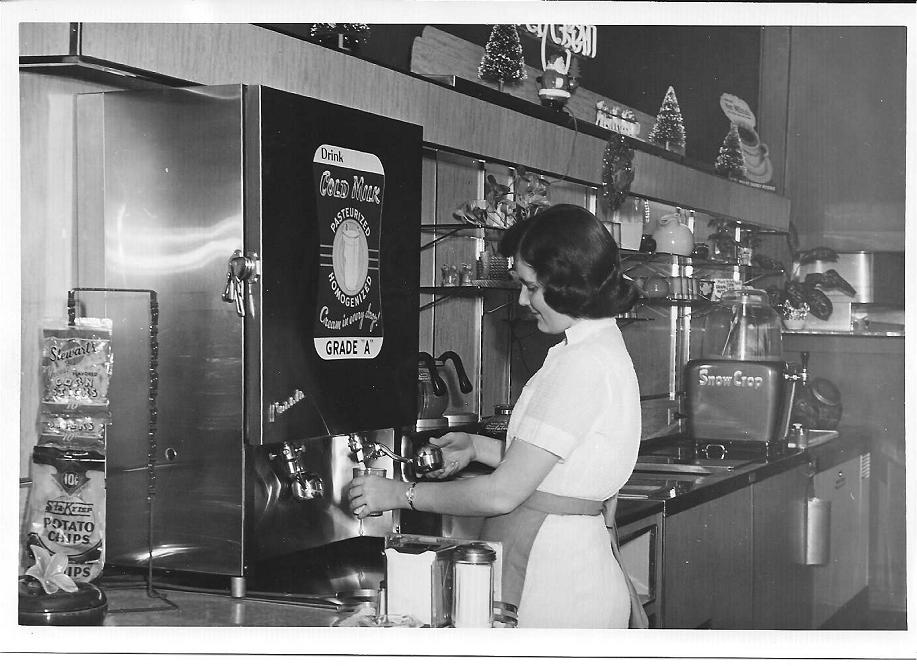
In several of the news releases about the exhibit, we used one of our favorite photographs.
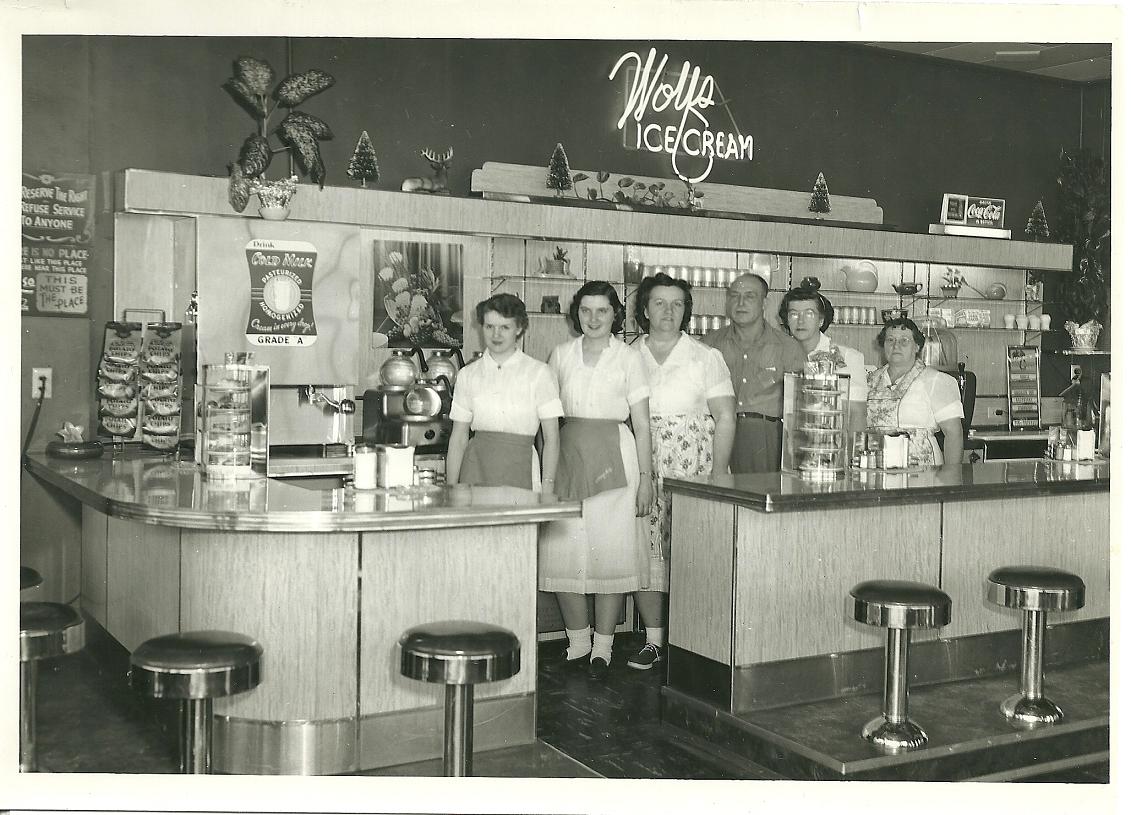
Like many of our photographs, this one had limited information associated with it.  The waitress was not identified and the only note on the back was "Cedar Village Cafe".  Photo tech, Linda Koppes, had tried to identify the location, but when she compared the counter and other features in the photograph with photographs clearly identified as Cedar Village Cafe in the Cedar Village Shopping Center at 11th & Washington Road in Newton, there were little discrepancies.  It was enough different that she could not say with absolute certainty that it was the same cafe.

Shortly after the photo appeared in the Newton Kansan, we received several calls.  One caller said, "I think that is my sister."  Helen Partridge came in to visit with Linda, and she brought more photos.


She identified her sister, Marilyn Havens Brickell as the waitress in the photograph and shared the above photo that gave a wider view of the counter and our next clue.  The "Wolfs Ice Cream" sign is clearly visible and that reminded Linda of another photograph from a newspaper.


Mr.& Mrs. Geer, Village Cafe
Newton Kansan, April 1, 1954
When the Cedar Village Shopping Center opened in the spring of 1954, the Newton Kansan printed a special edition featuring all the businesses.  Now we had a name, a confirmation of the place and a date for the photograph.  Linda also noted that based on the photographs in our collection, the lunch counter at the Village Cafe (now Curtis C's) has been changed at least three times. 

Village Cafe, Bob Zook, owner
One mystery solved.