Friday, March 8, 2013

Mustard Plaster and a Warm Iron: The Goerman Boarding House

by Kristine Schmucker, Curator
 
March has been designated as Women's History Month.  Although the stories of women can (and should) be told throughout the year, we will feature several stories about Harvey County women this month.  This post will focus on Augusta Goerman a woman who was willing to provide a home not only for her children, but also for strangers in her Newton boarding house.
 
One occupation that was open to women in the late 1890s was that of running a boarding house.  The story of one woman and her boarding house came to my attention through an object in the museum's collection - a silver ladle in a wooden box.


The the initials "AG" were inscribed on the ladle's handle. On the inside of the box a piece of paper was stuck with the date "1874".


When I looked up the number the only additional information was a brief note - "used in the Goerman House."  What was the story behind this object?

I discovered an Augusta Goerman listed in the 1903 city directory at 119 E. Broadway with the additional notation - boarding house. 
 
Newton City Directory, 1903
 According to her obituary, Augusta Goerman lived at 119 E. Broadway in Newton from the mid 1880s until her death in 1939. She was buried at the Hillside Cemetery in Wichita, Kansas, next to her ex-husband, Louis Goerman.  Based on her obituary and census records, the story of Augusta Goerman slowly came into focus.
 
Augusta was born in Germany on May 6, 1848, and at the age of 24 she immigrated to the United States. She married Louis Goerman in the mid 1870s. Perhaps, the ladle was a wedding gift. The marriage lasted for several years, but they divorced sometime before Louis Goerman's death in June 1884.    Augusta came to Newton in 1886 with her children Louis, Annie, Clara and Herbert. 

The 1900 census lists Augusta as 52 years old, "divorced, head of household", and the mother of four living children.  At that time, three of her children lived with her; Louis (22), Annie (20), and Herbert (11).  The census also lists seven men as "boarders". Later census' also list between one and six boarders - both men and women - living at Augusta Goerman's Boarding House.

Main & Broadway, Newton, 1919
Residence visible on east Broadway:
W.C. Handy (117) ; Mrs. Augusta Goerman (119) - indicated with red arrow.
HCHM Photo Archives
 Goerman House was ideally located within walking distance of Newton's Main Street and  business district.  Axtell Hospital and the Goerz Mill were also close by.  The location attracted many seeking a temporary home away from home to board with Mrs. Goerman.  Her obituary noted that she "operated a rooming and boarding house for 41 years.  Her Broadway residence had been the home of scores of Newton's professional men and women during that time."
 
Boarding houses provided an alternative to the hotel for travelers, especially for those that may need to stay in the area for longer.  Men working for the railroad frequently found themselves away from home and a boarding house provided a place to stay. Boarding was also a way for a family to make additional money. It was also an acceptable source of income for a widowed or divorced women.

Life in a boarding house provided comforts not readily available at a hotel as this article from June 1900 points out. 
"In a boarding house you can obtain a mustard plaster and a cupful of palatable gruel and a warm iron for taking out a spot of a velvet gown. They create  a home feeling which the hungry heart of the hotel dweller misses. . . . It is the conversation of the boarding house table that holds and thrills him and keeps his feelings young and homelike. . . . No one ever feels neglected in a boarding house."                                  ("Life in a Boarding House", Newton Kansan Evening Republican, 15 June 1900.)
No doubt the silver ladle was used to serve many  delicious dishes to hungry boarders and gives us a glimpse into one woman's life in Harvey County life a century ago.

ddd


****Note: Mustard Plaster is a home remedy for colds, wet cough, sinusitis and chest congestion. To learn how to make a mustard plaster visit the Natural Remedies Center at: 
http://www.naturalremediescenter.com/4177/mustard-plaster-a-home-remedy-for-common-cold-with-runny-nose-wet-cough-bronchitis-pneumonia-sinusitis-pleurisy-and-chest-congestion/

Sources:
  • Newton City Directories, 1885-1940, HCHM Archives.
  • HCHM Photo Archives
  • Newton Kansan Evening Republican, 2 February 1939.
  • United States Census, 1900, 1910, 1920, 1930.
  • "Life in a Boarding House", Newton Kansan Evening Republican, 15 June 1900.
  • Strasser, Susan, Never Done: History of American Housework. Henry Holt & Co., New York, 2000
Visit our web page at http://hchm.org/ to read our current newsletter.

Friday, March 1, 2013

"One of the Best Things For the Town: Chauncey A. Seaman and the Sedgwick Nursery"

Researched by museum volunteer, Thomas Carrell
Written by Kristine Schmucker, Curator 

In connection with our new exhibit featuring the oldest town in Harvey County, we will be posting articles highlighting the people and business of Sedgwick throughout the year.


On what was surely a hot Kansas day in August 1887, twenty-five year old Chauncey A. Seaman arrived in Sedgwick, Kansas. Eighteen years after  Charles Schaefer established the first business in Sedgwick, the town was thriving. 
 

Chauncey A. Seaman
 
A Kansas native, Seaman was born in Linn County, Kansas, on March 24, 1862.  Seaman, no doubt, was looking for a place to establish himself and make a life. He soon became involved in a local business, the Sedgwick Nursery, owned and operated by Samuel B. Shirk.
 
Sedgwick Nursery, 490 E. 7th, Sedgwick
ca. 1910
Photo taken from Glenn Manning Barn
HCHM Photo Collection
Shirk had moved to Harvey County from Lancaster, PA in 1884 with his wife Barbara, one son, David, and two daughters, Medessa and Anna, and started a nursery  business near Sedgwick.  The Sedgwick Nursery was located at 490 E. 7th near Sedgwick and consisted of 200 acres.
 
In 1886, Barbara died; a few years later Shirk married for the second time to  a widow, Anna Musser.  
 
Grafting, 1898
Photo Courtesy Sedgwick Historical Museum
Soon after Chauncey A. Seaman arrived in Sedgwick, he began working for Shirk at the nursery.  On September 10, 1889, Seaman married Anna Shirk. 
 
In 1892,  Seaman bought Sedgwick Nursery from his father-in-law. For the next several years, Seaman operated the successful business.  At some point John P. Schermerhorn became a business partner in the nursery.  In May 1900, Seaman sold his part of the business to Schermerhorn. 
 
Sedgwick Nursery
HCHM Photo Collection
 
The Sedgwick Pantagraph noted the change of ownership with praise for what the business had meant to the community.
 
"The Sedgwick nursery company, which organized several years ago proved one of the best things for the town that ever located here, as it gave employment to a large force of m en, conducted a big mail business which benefitted the post office and printer, and was an institution which advertised the town far and wide."  (Sedgwick Pantagraph, 3 May 1900)
 
Schermerhorn continued to operate a nursery in Sedgwick until approximately 1910. Seaman continued to actively work in the Sedgwick community, serving as mayor 1899 - 1900 and 1909 - 1911.  During this time he was also the president of the Sedgwick State Bank from 1900 to 1940.   Seaman retired in 1940 due to ill health and passed away at Bethel Hospital, Newton, on November 13, 1947.

Sources:
 Sedgwick Historical Museum Photograph Collection
 Sedgwick Pantagraph, 3 May 1900
Sedgwick Pantagraph 26 October 1911
Evening Kansan, 12 March 1935;
"Chauncey A. Seaman Obituary", ND, original in possession of Deborah Austin
  
Sedgwick Nursery
ca. 1910
HCHM Photo Collection


Wednesday, February 20, 2013

A Front Row Seat to History

by Kristine Schmucker, HCHM Curator

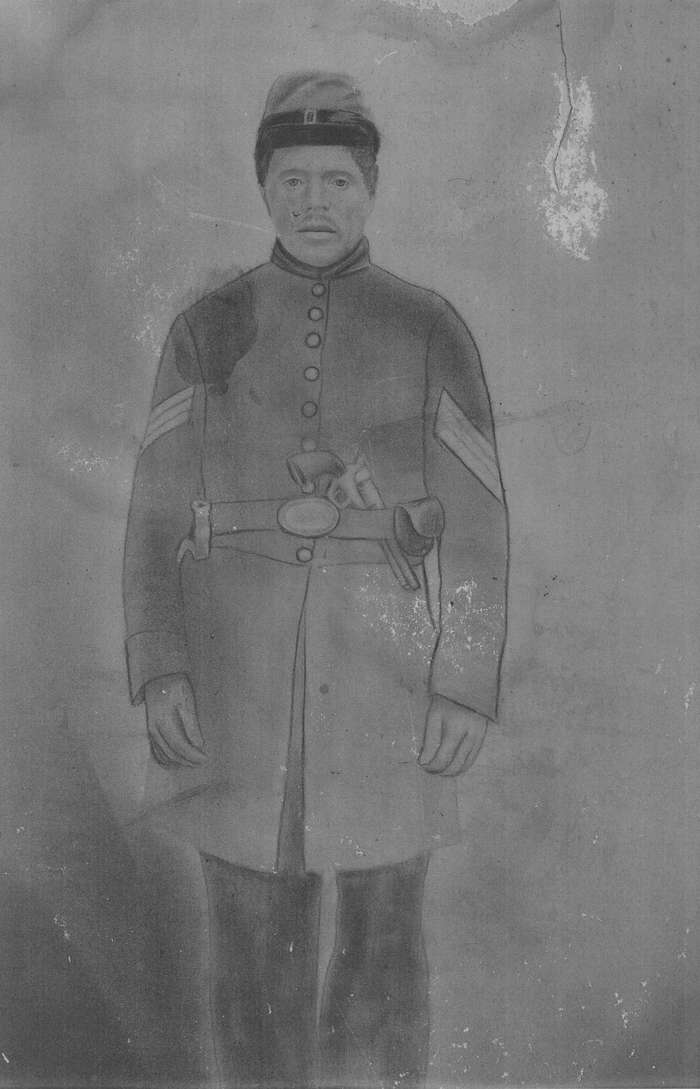
This post continues the story of Charles Schaefer of Sedgwick, Ks


This past Monday, we celebrated President's Day.  Most of us will  never have the chance to meet the President of the United States, but one Kansan did.  In later years, Schaefer  recalled his experiences as a  soldier in the capitol during which time he met President Lincoln.

In his handwritten notebook of remembrances, Schaefer related his impressions of President Abraham Lincoln.
"A very queer man. . . Personally there was much good about him which was alright in civil life, but in war was not good.*  I met him face to face between the White House and Treasurery Building, stood at attentions and saluted as was proper.  He certainly was the homeliest man I ever saw; stove pipe hat, big clothing that did not fit.  But I gave him a square good look in the eyes and I do not believe I ever saw a kinder and sympathetic [person].  I rather pity him, he looked so lonesome and sorrowful. . . Of course, I saw him several times at Grand Reviews."
In this faded clipping from an undated Wichita Eagle, Schaefer recalled an incident from the close of the Civil War related to the assassination of President Lincoln.
Newspaper clipping in the Schaefer Scrapbook
Sedgwick Historical Society
Sedgwick, Ks
Schaefer was regimental quartermaster sergeant of the Third United States Infantry and he had been ordered   to Washington D.C. at the close of the war.  He was given rooms in the federal penitentiary while he worked to return supplies.  It was during this time that he made the acquaintance of several sailors and they had a tale to tell him.  He was pledged to the utmost secrecy and was told of the mysterious activities that the sailors had completed under orders.  
"Eight sailors of the U.S. nave detailed to have charge of a boat kept in readiness for the governments use. . . . One night they had been called upon to take their boat and row upstream til they found a ship on the other side of the Potomac. . . . When the drew alongside the ship, they were stopped and a box, casket-shaped, was lowered into their boat and they were ordered to return to shore."
Schaefer continued to describe how the sailors were blindfolded and "marched around until they did not have the least idea where they were." The blindfolds were removed and they found themselves in a "large barren room with flagstone floor."  The sailors were then ordered to remove the flagstone and dig a specific sized hole. The specifications they "noticed were the size of a grave. . . . they were ordered to place the box" from their boat in the hole.  Next, they were to "replace the stone and remove all traces of the night's work."  Once returned to their boat they were "dismissed with the order to keep their mouths shut."
The men were sure that they recognized the room as one in the Old Penitentiary and they were convinced that the body was that of John Wilkes Booth.

Schaefer concluded his story by noting:
"I promised I would not repeat the information since they were under orders to keep still. I kept my word until this long distant date when telling can do no harm." 

When I first read this story in the Schaefer Scrapbook I thought it was a 'tall tale', but a bit of research supported much of what Schaefer described.  Booth was shot through the neck by Sergeant Boston Corbett on the porch of Richard Garrett's house near Port Royal, Virginia, where he died.  The body was sewn up in a horse blanket and taken to Belle Plain where it was hoisted upon the deck of steamer John S Ide.  

The body was delivered to the Montauk where an autopsy was performed April 27, 1865.  Booth was identified by several people who had known him well, including Dr. John Frederick May.  Dr. May had recently removed a large fibroid tumor from Booth's neck and the scar was still visible on the body. Booth's dentist also positively identified the body.

The Secretary of War Edwin Stanton ordered the body to be buried in the Old Penitentiary on the Washington Arsenal grounds - exactly where Shaefer was staying in 1865. This was accomplished. 


John Wilkes Booth's Autopsyhttp://rogerjnorton.com/Lincoln83.html

In 1869, the body was exhumed and positively identified and returned to the Booth family.  Booth was buried in an unmarked grave in the family plot in Green Mount Cemetery, Baltimore on June 26, 1869.

Sources: 


For information on the mystery and legend that surrounds Booth's body visit: http://www.historybuff.com/library/refbooth.html; 

*Schaefer had some very strong opinions about the dismissal of Union General McClellan.  He noted that the General, known as " 'Little Mac' . .  was too much the loyal soldier."

Visit our web page for museum events - http://hchm.org/

Thursday, February 14, 2013

"A Good English Name"


By Kristine Schmucker, Curator

This is the third in our series featuring the Rickman/Anderson/Clark families who settled in Harvey County in 1871.

Mary Ruth Martinsdale Rickman
Photo Courtesy Jullian Wall
Englishwoman, Mary Martinsdale arrived in Newton  to answer an advertisement for a mail-order-bride placed by Patrick Rickman of Newton, Kansas.  Much to her surprise, her future husband was black. She had answered the ad because "Rickman was a good English name, but now that she was here he was stuck with her." 
("On Equal Ground"  by Judy Burks, Newton Kansan, 125th Anniversary, Section B)

They wasted no time. Mary and Patrick were married March 17, 1911. 

Mary was born on a farm near Liverpool, England on October 22, 1872.  She had come to the United States at the age of 14 "to work for a family." Not much else is known of her life prior to coming to Kansas. In the spring of 1911, at the age of 39 she traveled to Newton, Kansas to meet her future husband.

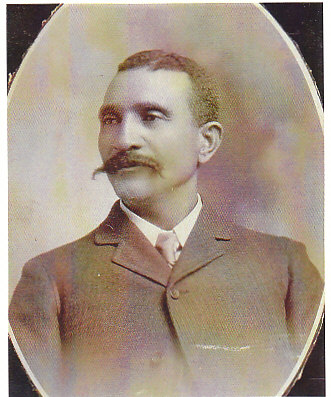
Patrick Rickman  was a well-known and respected craftsman in Harvey County.  Born in White County, Tennessee on July 31, 1857, Pat came to Harvey County in 1879.  Here, he joined his father, Joseph Rickman, and aunt, Mary Rickman Anderson Grant.  He learned the trade of brick mason.

In 1882, he married Amanda Burdine and they had four children; Angus and Guy, who died young, and Hazel and Lloyd who lived to adulthood.  Pat and Amanda divorced in the fall of 1899.
Patrick Rickman
Photo courtesy Jullian Wall
At the time of his death, Pat Rickman was "one of the best known workmen in this section, as well as one of the most dependable, respected workman.  Many a building  stands today as a monument to his skill and industry." (Evening Kansan Republican, 25 August 1926, p. 2.)

His daughter, Hazel, later recalled the times she brought lunch to her father (Pat) while he was working on the foundation of Bethel College Administration building.  According to family tradition, Patrick Rickman was the head of the construction company that employed several members of the larger Rickman/Anderson family.This company worked on the foundation of the building for the new Mennonite college.*

Ad Building
Bethel College Administration Building
1888-1893*
After the death of Patrick, his wife Mary, "worked as a private nurse having in her care, until their death, several of Newton's widely known and highly respected citizens."  In her obituary, Mary was described as "kind and loving, patriotic and charitable." She was survived by her step-children, Lloyd Rickman and Hazel Rickman Rossiter. Services for Mary were held at St. Mary's Catholic Church in Newton.  The pallbearers were  members of her adopted American family, the Rickmans, Andersons, and Rossiters. (Evening Kansan Republican, 12 Aug. 1943, p. 2.)


During the month of  February, in honor of  Black History Month, we will be featuring related stories from Harvey County. Much of the information on the Rickman/Anderson/Grant family is based on oral traditions preserved by Marguerite Rickman Huffman & June Rossiter Thaw and research by Karen Wall.  We are grateful for their willingness to share the stories of this Harvey County family. 


For the first installment which features Mary Rickman Anderson Grant see: http://harveycountyvoices.blogspot.com/2013/01/an-ordinary-amazing-woman-mary-rickman.html.  For the second installment that features her brother, Joseph Rickamn, see: http://harveycountyvoices.blogspot.com/2013/02/stone-mason-joe-rickman.html

For more about the early life of Patrick Rickman   http://hchm.org/old-story-murder-main/


*No records have been found that identify who constructed the first half or foundation of the Ad Building. "On Equal Ground"  by Judy Burks, Newton Kansan, 125th Anniversary, Section B
Sources: 
  • Harvey County Historical Museum & Archives Marriage Certificate - March 17, 1911
  • Harvey County Historical Museum & Archives City Directories 1885-1926
  • Evening Kansan Republican, 25 August 1926, p. 2.
  • Evening Kansan Republican, 28 August 1926, p. 2.
  • Evening Kansan Republican, 12 Aug. 1943, p. 2.
  • "On Equal Ground"  by Judy Burks, Newton Kansan, 125th Anniversary, Section B

To view the complete inventory of Marriage Certificates at the Harvey County Historical Museum & Archives, visit http://hchm.org/ and click on the 'Research Library' tab.

Friday, February 8, 2013

Stone Mason - Joe Rickman

by Kristine Schmucker, Curator

This is the second in our series featuring the Rickman/Anderson/Clark/McWorter families who settled in Harvey County in 1871. For the first installment which features Mary Rickman Anderson Grant see: http://harveycountyvoices.blogspot.com/2013/01/an-ordinary-amazing-woman-mary-rickman.html

Not as much is known about Mary Rickman Anderson Grant's eldest son, Joseph C. Rickman.

Joseph C. Rickman
Photo Courtesy Jullian Wall
Joseph Rickman was twenty-one years old when he came to Kansas with his mother, Mary Rickman Anderson, to homestead alongside his stepfather, David, sisters; America, Lucy and Tennessee, and brothers; Wayman, Jefferson, and Nathaniel.

Rickman Anderson Brothers
A few years later, Joe returned to Tennessee for a brief time.  On October 26, 1874, he married Lucinda Paige.  The newlyweds returned to Harvey County and Joe farmed.  They had five children, the three girls Linnie, Estelle and Alta died very young and were buried on the Rickman homestead.  Only the two boys, Clarence (b. 1884) and Ocran (b. 1889) lived to adulthood.  

Lucinda Paige Rickman
Photo courtesy Jullian Wall
Joe and Lucinda had moved to Newton by 1885. The family was living at 424 w 5th and  Joe was working as a laborer.  Two years later, Joe is listed as a stone mason.  According to family tradition, he helped to build the Warkentin Mill (today known as the Old Mill), Newton and the Administration Building on the Bethel College Campus, North Newton. It is not known what other buildings Joe might have worked on over the span of his career.  He also could have been part of the crew, along with nephew Pat Rickman that  laid the bricks for Newton's streets. 

Warkentin Mill & Train Yards at Main & Third,
Newton, Ks, ca. 1915 
By 1905 the family had moved to 114 W 4th Newton. Joseph C. "Joe" Rickman died in May 1918 at the age of 68.  Lucinda lived at 114 W 4th until her death in 1931 at the age of 76.  

Clarence, son of Joe C. and Lucinda Rickman, owned and operated a "recreation parlor" located at 114 W 4th, Newton for a number of years, possibly from 1911 - 1913.  Clarence was married to Jessie J. Greenboam, a native of London, England, on June 13, 1917.  

Ocran,  served in World War I.  At the time of his death in 1955, he was living in Omaha, Nebraska.


During the month of  February, in honor of  Black History Month, we will be featuring related stories from Harvey County. Much of the information on the Rickman/Anderson/Grant family is based on oral traditions preserved by Marguerite Rickman Huffman & June Rossiter Thaw and research by Karen Wall.  We are grateful for their willingness to share the stories of this Harvey County family. 

Sources: 

  • Newton City Directories, 1885, 1887, 1902, 1905, 1911, 1913, 1918. Harvey county Historical Museum & Archives, Newton, Ks
Visit our web page at http://hchm.org/

Thursday, January 31, 2013

An Ordinary, Amazing Woman: Mary Rickman Anderson Grant

by Kristine Schmucker, Curator


"Mrs. Mary O. Grant, colored, aged 95, one of the oldest residents in this county  died Tuesday night at 11:30 . . . "

At the time of her death in 1923, Mary Rickman Anderson Grant was among the last of the first settlers of Harvey County, but her name never appeared in any of the old settler lists. She is not pictured in the Kansan 25th Anniversary Edition printed in August 1922, a year before her death.  Her story, and that of her pioneer family, remained alive through oral tradition within the larger Rickman/Anderson/McWorter/Clark  families.

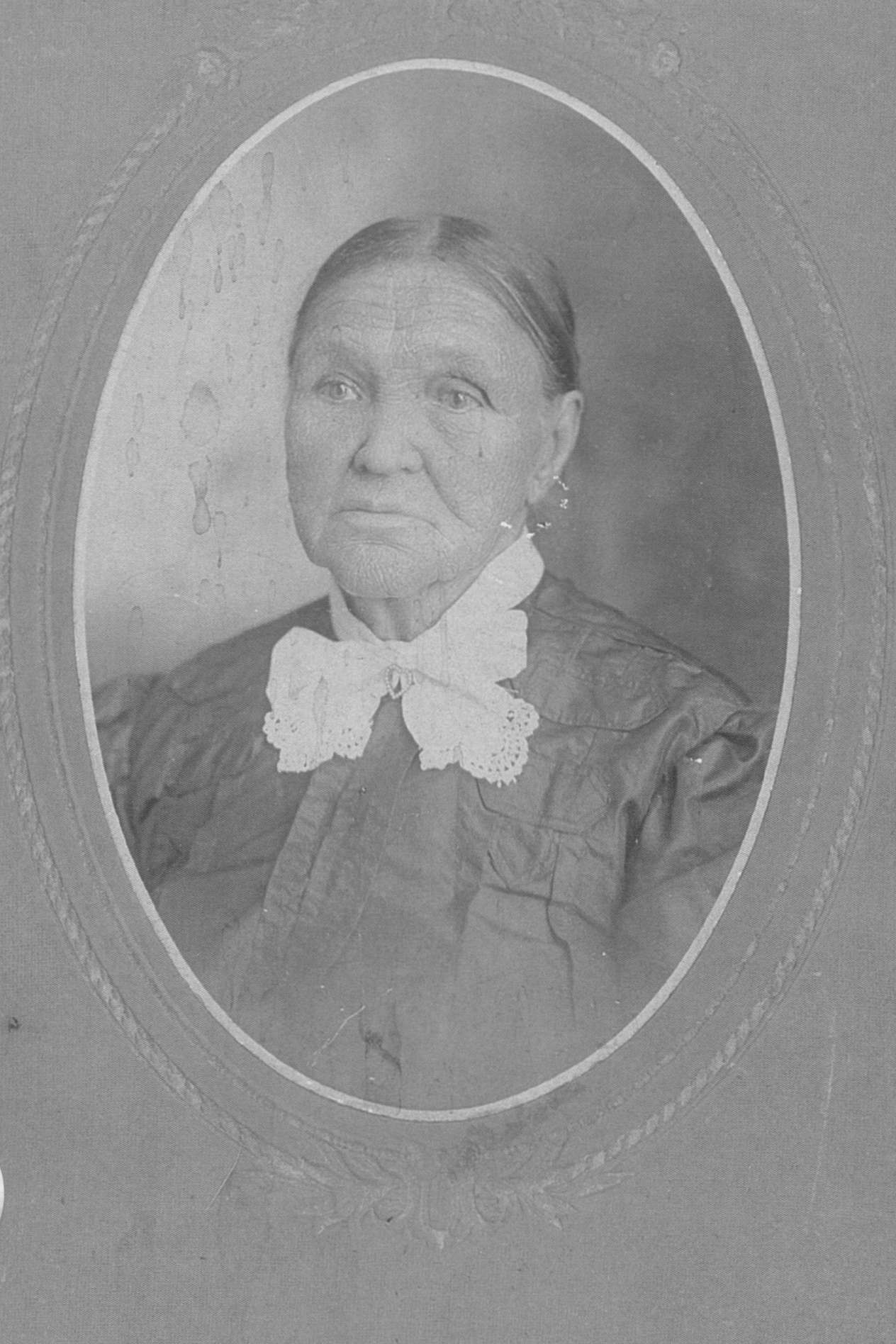
Mary Rickman Anderson Grant
Harvey County Pioneer
Photo courtesy Jullian Wall

Mary's story starts  in Sparta, White Co., Tennessee where she was born April 1835.  Her father's name was Nathanial  Rickman and her mother's name may have been Sophia.  In the 1860 Census, Mary is listed as the head of household with four children, Joseph, America, Lucy and Tennessee.  At some point she met and married David Anderson and moved to Ohio.  David Anderson served in the Civil War in Co I 14th Reg. U.S.C.T., which was the same regiment as Mary's brother Joseph Rickman.  Perhaps he introduced Anderson to his sister and they got married.  By 1870, the entire Anderson family was living in Clemont County, Ohio with David listed as head of the household with three more children; James Wayman, Thomas Jefferson, and Nathanial.  A daughter, Carrie, is born later that year.

Homesteading on the Prairie

In 1871, the Anderson family decided to move to Kansas. Like many black families they saw the opportunity to own  land. The Homestead Act of 1862 allowed a citizen to file "first papers", pay a $10 fee and claim 160 acres of land in the public domain.  The Anderson family left all that they knew and traveled by covered wagon to Emporia, Kansas for a chance to own their own land. From Emporia, they traveled to Florence, Kansas, where the family stayed  in a dugout while David Anderson went on to the homestead site in Pleasant Township, Harvey County.  Here he began building a new home, but met with misfortune almost immediately.  One of the horses died, leaving only one older horse for the difficult work of breaking the prairie sod.  Anderson decided to trade the horse for a pair of oxen and continued to work on improving the claim.
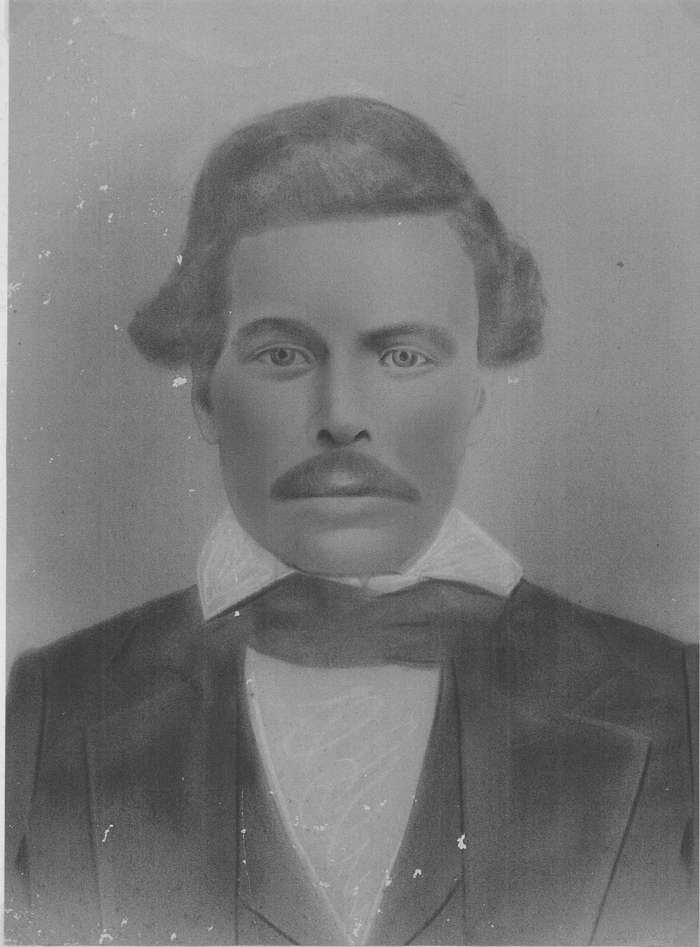
David M. Anderson
Mary's 1st husband
Photo courtesy Jullian Wall

Anderson filed for a homestead in Harvey County, Pleasant Township, Section 26, but he did not live to see the fruits of his efforts.  David died on April 3, 1872, leaving Mary with eight children on the prairie.  He was buried on the homestead.
1885 Atlas
Pleasant Township, Harvey County
Mary was determined to keep the homestead. Other members of the family helped her complete a sod house.  For the first several years, Mary lived in the small soddy with her eight children, four boys, and four girls.  The boys "slept in swinging beds hung from the cellar rafters so that they would be protected from snakes and insects."  Wild life of all types, from wolves and coyotes to buffalo would come within a short distance of the house. Fuel was scarce, so like other homesteaders, the Anderson family relied on cow-chips and corn stalks for cooking and heating.  From the homestead it was an all day trip to Peabody, the site of the nearest mill for the Anderson family.  The older boys would take a sack of corn and go by horse to the mill where the corn could be ground into cornmeal.

Death from accident or illness was a constant threat to the new settlers.  In 1872, Mary's daughter, America Turner died.  Three granddaughters, Estelle & Linnie (1879) and Alta (1881) also died and were buried in the family plot on the homestead. 


Challenges on the Prairie

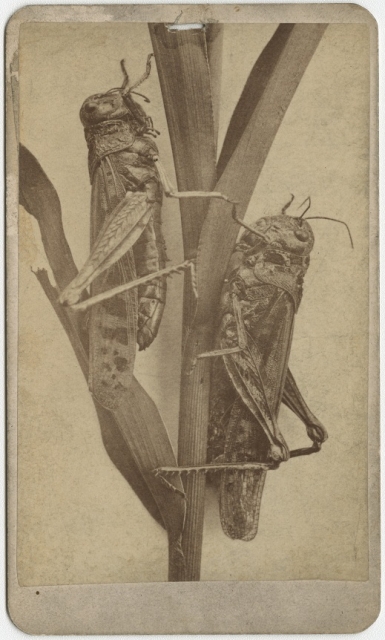
An early challenge that faced the Anderson family was a  winged creature known as the Rocky Mountain Locust. August 7, 1874 no doubt started out like any other day for the Anderson family.  Perhaps Mary was up early make breakfast when she noticed that the sky seemed to be darkening.  At first she may have thought the low, dark gray cloud "being blown swiftly from the north west" was a rainstorm.  It was soon apparent that this was something else entirely.  Billions of grasshoppers had arrived in "swarms so large they blocked out the sun."  For three days the locusts, only 1.25-1.4 inches long, whirred and chewed their way across Harvey County.  In their wake, total destruction.  
"At the end of that time every stalk of corn and garden and every vestige of vegetation that was green enough for them to eat simply was not.  It did not exist.  All paint and even the old black  boards and logs were eaten until they looked like new lumber." ("Anderson,Rickman, & Rossiter Family Reunion Picnic" by Marguerite Huffman, ca. 1981 in Harvey County Residents Box 1B, Rickman/Anderson File Folder 35)
The Locust Plague, by CV Riley, 1877
The green shows the hardest hit.
http://rainydayreadings.blogspot.com/2010/06/topics-in-research-great-grasshopper.htm


Minnesota locusts of the 1870s
http://www.mnopedia.org/multimedia/minnesota-locusts-1870s
This species was not a grasshopper, rather a Rocky Mountain Locust which went extinct around 1902.
See also http://www.hcn.org/issues/243/13695

The Anderson family confronted another challenge of the prairie.  In 1876, a prairie fire broke out near Whitewater, south and east of the Anderson claim.  Soon the flames were sweeping across Harvey County in a ten mile wide swath.  A neighbor  lost his barn and 20 head of cattle.  Young Jefferson Anderson was home alone at the time.  He did the only things he could think of - he turned the oxen loose and chased them to the creek.  Amazingly, the house was spared.  The main loss was of a pig pen and a stable. 
Orison Grant
Wearing his Civil War Uniform
Mary's 2nd husband
Photo Courtesy Jullian Wall

Forty-six year old Mary Anderson married Orison Grant, a Civil War veteran, in September 1878.  A Justice of the Peace performed the ceremony.  Grant  was 61 at the time according the marriage license.


Grant had also come to Kansas in search of land to call his own.  He settled on a claim in Highland Township in 1871.  After their marriage, the Grants sold the Highland claim in two parts; the first in 1885 for $1350 and the second in 1886 for $2000.  

1885 Atlas
Highland Township, Harvey County


In 1889, Mary made the final $8.00 payment on her homestead in Pleasant Township - the farm was officially hers.


Orison Grant died February 3, 1893.  His obituary noted that "people that knew him intimately dubbed him 'General' which title always pleased him.  He was respected by all who knew him." (Newton Kansan, 3 February 1893, p.3)


Keeping the family together


Mary stayed on the homestead until 1910.  At that time she sold the farm for $8,500.  Family was important to Mary and  it was important to her that the family stayed together.    When she moved to Newton, she had the six members of the family who had been buried in the family plot on the farm moved to Greenwood Cemetery, Newton.

For the next thirteen years Mary lived with her daughter, Lucy Rickman Mayfield at 330 E. 6th, Newton.  Mary Grant, Harvey County pioneer, died August 1, 1923 at the Mayfield home.
Mary Rickman Anderson Grant and Lucy Rickman Mayfield 
During the month of  February, in honor of  Black History Month, we will be featuring related stories from Harvey County. Much of the information on the Rickman/Anderson/Grant family is based on oral traditions preserved by Marguerite Rickman Huffman & June Rossiter Thaw and research by Karen Wall.  We are grateful for their willingness to share the stories of this Harvey County family. 

Sources
  • Anderson,Rickman, & Rossiter Family Reunion Picnic" by Marguerite Huffman, ca. 1981 in Harvey County Residents Box 1B, Rickman/Anderson File Folder 35)
  • Evening Kansas Republican, 1 August 1923, p. 5.
  • Newton Kansan, 3 February 1893, p.3
  • Karen Wall, Find-A-Grave, "Mary Rickman Anderson Grant."

Visit http://hchm.org/ for more information on the Harvey County Historical Museum & Archives.

Thursday, January 24, 2013

Sharing the Fun! A Recent Acquisition at the Museum

by Kristine Schmucker, Curator

Recently, a collection of childrens clothing was donated to the museum. Each handmade item was carefully labeled with who wore it and the year.  This adds so much to the object!  

The long christening gown was worn by Reba Essie Workman Hicks, Emporia, born June 6, 1888. I can imagine a young woman carefully creating this beautiful garment for her unborn child 125 years ago.
Lucinda, the doll, was purchased by Lola Blanch Hicks December 24, 1929. 
Christening gown and Doll
The collection of children's clothing was made by Lola Blanch Hicks Baldwin between 1939 and 1943 for her children; a daughter, Everell D. Hicks Francisco, and son, Lawrence Hicks.

Dress worn by Everell E. Baldwin, 1943

Crochet Apron, 1939-1943

Dress, slip and hood, 1939-1943

Dresses, 1939-1943
 Crocheted and knitted items used in the Hicks home 1939-1943.


Booties and Mittens, 1939-1943
Visit http://hchm.org/ for more about upcoming activities at the museum.